Posted on 02 December 2011. Tags: Afghanistan, Gulnaz, Rape, unjust imprisonment

Sources: CNN, U.S. State Department, The Chronicle of Higher Education
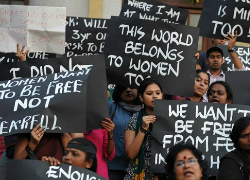
An Afghan woman, 21 year-old Gulnaz, was sentenced to twelve years in prison for adultery because she was raped by a man who was married to her cousin. In Afghanistan, a rape victim can be charged with and convicted of adultery if the rapist is married at the time of the attack.
The rape took place two years ago, and Gulnaz conceived a child as a result of the attack. The authorities are allowing Gulnaz to raise her young daughter in prison. Gulnaz has agreed to marry her attacker in order to legitimize her daughter and be released from prison early.
In addition to adultery, Gulnaz is also serving time for “failing to report the rape in a timely manner,” which carries a separate penalty that requires additional jail time under the Afghan criminal code.
Gulnaz had few options after she discovered that she was impregnated by her attacker. Michele Goodwin of The Chronicle explains, “Had Gulnaz remained silent, she might have brought dishonor on her family for an out-of-wedlock pregnancy. That could have resulted in murder—an illegal, but nonetheless customary practice in dealing with women who “dishonor” their families.”
A spokesman for the Afghan Attorney General, Rahmatullah Naziri, told CNN that Gulnaz’s sentence was reduced to three years, leaving one year left for her to serve before she will be released and allowed to marry her attacker.
The barbaric nature of Gulnaz’s options after her rape and pregnancy have not been lost on the international community. Afghanistan’s President Hamid Karzai received a petition on Sunday calling for the immediate release of Gulnaz. Nearly 5,000 people had signed the petition in just 48 hours, yet Karzai has not acknowledged the petition.
The U.S. State Department acknowledged Gulnaz’s awful predicament, and made a statement last Thursday:
“Gulnaz’s situation is one no woman should have to face. Our heartfelt condolences go out to Gulnaz and her young daughter. The Law for the Elimination of Violence Against Women was a major advancement for the rights of women in Afghanistan; but without full training and implementation, situations such as this one will continue to occur. We expect Afghan prosecutors to properly apply the law while also upholding Gulnaz’s rights.”
The effectiveness of The Law for the Elimination of Violence Against Women in the face of such a blatant and violent attack on an Afghan woman remains to be seen.
Posted in DJILP Staff, TVFA Posts
Posted on 16 August 2011. Tags: Butare, Genocide, Murder, Nyiramasuhuko, Pauline, Rape, Rwanda
The United Nations International Criminal Tribunal for Rwanda issued its judgment earlier this summer in the case of Pauline Nyiramasuhuko et al.
The Rwanda Tribunal has been working for 17 years and it has completed 50 genocide trials. Its judgments are now issued with comparatively little fanfare. But the Nyiramasuhuko judgment is extraordinary and merits a closer look.
Nyiramasuhuko, often referred to as simply “Pauline”, is first woman at the Rwanda Tribunal to be charged with genocide and the only women ever to be convicted. Pauline’s case concerned the town of Butare in Rwanda, a University town whose mayor bravely resisted the national government’s unfolding genocidal plans providing a safe harbor to thousands of desperate Tutsis. Nyiramasuhuko was instrumental in having the mayor sacked and later murdered to pave the way for the killing. She then proceeded to be a pivotal figure in the massacre of thousands of Tutsi refugees.

Pauline Nyiramasuhuko
Nyiramasuhuko was the first woman to be convicted of rape as an act of genocide. After the genocide but prior to her arrest, she was interviewed by the BBC in a Congolese refugee camp in 1995. She told the BBC she was not involved in the killings: “I couldn’t even kill a chicken. If there is a person who says that a woman, a mother, could have killed, I’ll tell you truly then I am ready to confront that person.” It turns out, this woman and mother not only had many Tutsis killed based on her direct orders but also ordered many women to be raped.
Nyiramasuhuko was the Minister of Women’s Development in Rwanda. Nyiramasuhuko held a Ministerial post in the extremist Rwandan government. It was cruel irony that the Minister of Women’s Development so brazenly ordered women to be raped and machete’d to death.
Nyiramasuhuko was convicted of conspiracy to commit genocide. The Nyiramasuhuko case was one of the rare cases where a Rwandan Trial Chamber issued a conviction on the conspiracy mode of liability. More often than not, Trial Chambers have not been persuaded by the evidence offered by the prosecution that an agreement to commit genocide existed. Only the Nazis wrote down their explicit genocidal plans, for the other genocides the evidence of conspiracy tends to be circumstantial. In Pauline’s case, however, the Trial Chamber found that the evidence clearly established Pauline audaciously conspired with her son and others to eliminate the Tutsi in Butare.
Nyiramasuhuko was the first person to be convicted for committing genocide with a son. The one thing you can say in Pauline’s favor is that she had a close-knit family. One of Pauline’s co-defendants was her son, Shalom Ntahobali. Evidence at trial established that Pauline ordered her son to abduct and rape Tutsi women. And being a good son, he complied.
Posted in David Akerson, TVFA Posts