Posted on 06 February 2012. Tags: Bahrain, David Akerson, Human Rights, Ved Nanda Center for International and Comparative Law
A report released today by the Ved Nanda Center for International and Comparative Law found that the government of Bahrain is continuing to prosecute civil society leaders in violation of international law and the recommendations of a government-appointed human rights commission. The trial of human rights attorney, Mohammad al-Tajer, is scheduled for February 7th while the appeal of labor leader, Mahdi Abu Deeb is scheduled for February 19th.

Human rights attorney, Mohammad al-Tajer
“The government of Bahrain would clearly like to sweep these cases under the rug,” said Prof. David Akerson, a lecturer at the University of Denver Sturm College of Law. “But our review indicates that the government is prosecuting these civil society leaders merely for calling for democratic reforms despite repeatedly saying that it is committed to implementing the recommendations of the commission.” Akerson is a former prosecutor at the UN-International Criminal Tribunal for Rwanda and the UN-International Criminal Tribunal for the former Yugoslavia.
In the wake of a brutal crackdown on protestors last year, the king of Bahrain appointed an international commission to evaluate allegations of human rights violations. The commission found that roughly 300 individuals were prosecuted in violation of their right to freedom of expression. The commission also found that the government engaged in a systematic campaign to “terrorize” civil society leaders, tortured detainees and prosecuted individuals in military courts that failed to adhere to basic international and domestic due process standards. It recommended that the government release all individuals that were prosecuted merely for calling for democratic governance.
Abu Deeb led a strike in which eighty percent of Bahrain’s teachers participated. He was allegedly thrown from a building during his arrest and his tortured confession was admitted against him at trial. Al-Tajer was the subject of an intimidation campaign, including receiving a video of himself sleeping in his bed at home.
“Unlike other Arab states where massive protests have succeeded in starting the reform process, the protests in Bahrain have been stymied by a brutal crackdown on civil society leaders,” said Ahmad Assed, co-author of the report and a defense attorney with significant domestic and international criminal experience. “If the government refuses to release these advocates for non-violent, democratic reforms, it may undermine prospects for a peaceful transition to democracy.”
While President Obama criticized the crackdown and Sec. Clinton called on the government to implement the recommendations of the commission, the State Department recently decided to proceed with military assistance to Bahrain, despite protests from human rights groups. Major protests are planned this weekend to mark the anniversary of the protests.
The full report is available here.
Posted in Jon Bellish, TVFA Posts
Posted on 03 November 2011. Tags: Bahrain, dispute resolution, King Hamad bin Isa Al Khalifa, National Consensus Dialogue

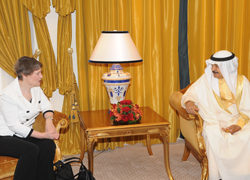
Helen Clark meets King Hamad bin Isa Al Khalifa (courtesy of UNDP)
Like many countries in the Middle East, Bahrain is undergoing tensions and changes manifested in the “Arab Spring” uprisings. Bahrain’s monarchy and citizens are engaged working to to determine the future shape of the country’s government through a dialogue centered on acceptable forms of government, citizen participation, and ways to sustain the country’s position as an economic hub in the region. While some engagement is taking place on the streets, international reviews of the government’s actions regarding human rights during demonstrations also play an important role.
In June, as part of the national response to public protests, convened a National Consensus Dialogue to engage representatives from political groups, civil society, the economic sector, and expats in discussing and making recommendations to the monarchy for proposed changes in the country in the areas of politics, rights, economy, and social services. At the request of the government, the Bahrain Chamber of Dispute Resolution (BCDR) secured the services of CDR Associates Partners, Christopher Moore and Susan Wildau, to consult on the dialogue process and conduct a five-day seminar on Facilitation of Multiparty Dialogue Groups. The training program prepared 17 Bahraini nationals to facilitate a 300 person dialogue group and multiple 70-person working groups. The Dialogue presented its report to His Majesty King Hamad bin Isa Al Khalifa at the end of July. In October, the monarchy began its responses to the recommendations.
While the results of the dialogue have not yet resulted in the changes requested by some leading political associations and civil society groups, and there have been questions about the inclusiveness and participation in the process, it has opened a political space for a range of governance, economic and social issues to be raised and addressed and proposal for change to be presented to the government. It is now up to the government to respond.
For more information on CDR’s work with the Bahrain National Dialogue, contact Christopher Moore or Susan Wildau at 1-800-MEDIATE or cmoore@mediate.org.
Posted in CDR Associates, TVFA Posts
Posted on 26 October 2011. Tags: Bahrain, criminal liability, human rights abuses, United States government

Zaynab Alkhawaja, daughter of Bahraini human rights activist Abdulhadi Al Khawaja
If the U.S. approves the next shipment of arms to Bahrain, should it be liable for aiding and abetting violations of international law committed by Bahrain?
The answer is clearly yes based on the precedent of the prosecution of former Liberian President Charles Taylor. Taylor is awaiting a final judgment from the Special Court for Sierra Leone for aiding and abetting in crimes against humanity, war crimes, and other serious violations of international humanitarian law. Taylor’s principle role in the conflict in neighboring Sierra Leone was to provide a violent rebel group with weapons — with full knowledge of the egregious crimes that group was committing. The U.S. is in a similar position with Bahrain. It is contemplating giving the criminal Bahraini regime weapons, knowing it is currently committing serious violations of international law.
There is little dispute that Bahrain has committed crimes against humanity against Bahraini citizens. Since February 2011 the government has been waging a violent crack down on opposition protesters. The internationally-respected Bahraini human rights activist Abdulhadi Al Khawaja is but one example of the thousands of victims of Bahrain’s repressive, heavy hand. Al Khawaja is a leader of the protest movement that seeks democratic reforms through peaceful protests, ala Ghandi and Martin Luther King. For the last 7 months, Al Khawaja has been detained incommunicado, subjected to severe torture and beatings. At his first court appearance, his face was beaten so badly that he was unrecognizable in the courtroom, his jaw fractured in four places. A secret military court hastily charged and convicted Al Khawaja under a murky “terror” law and sentenced him to life in prison without the pretense of a fair trial. He was not allowed to call a single witness in his defense. His final appeal before the Court of Cassation is due on October 30, 2011.
In this context, the U.S. contemplates sending arms to Bahrain. In September of this year, Bahrain requested 53 million dollars of military equipment from the U.S., including “44 Armored High Mobility Multi-Purpose Wheeled Vehicles, a variety of wire guided missiles, Night Sight Sets, spare parts, and other support and test equipment.” The timing of this request is quite suspicious. To its credit, last week the U.S. State Department decided to temporarily halt the arms shipment precisely due to Bahrain’s horrific human rights record. This clearly establishes the U.S. has knowledge about the crimes of the Bahraini regime.
The U.S. knows all too well the Taylor case and its aiding and abetting theory. The Special Court for Sierra Leone is prosecuting Charles Taylor and the U.S. was the court’s major funder. Moreover, its former chief prosecutor is Steven Rapp, is currently a high-ranking State Department official (the Ambassador-at-Large for War Crimes) who has direct access to Secretary Clinton. Thus, the U.S. cannot disavow itself of the legal principles of the Taylor case that it has so strongly advocated. The U.S. must suspend all arms shipments to Bahrain until Bahrain releases all political prisoners, terminates all pending criminal prosecutions and ceases its violent crackdown of peaceful protests.
An online petition has been created, requesting the Bahraini King, Prime Minister, and of Minister of Justice and Islamic Affairs to release Al Khawaja. Please sign this petition!
Posted in Michelle D. Quintero Millan, TVFA Posts