Posted on 22 November 2011. Tags: ICTR, international criminal tribunals, Nuremberg Tribunal, Rwanda
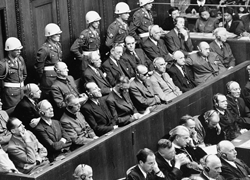
One of the biggest criticisms of the WWII Nuremberg Tribunal was that it was victors justice: the statute only authorized prosecution of crimes committed by the Axis. In addition, both the prosecutors and judges were comprised of nationals from the victorious powers: American, British, French and Soviet.
In subsequent tribunals, international justice has sought to avoid the appearance of victor’s justice with different approaches. Some tribunals have sought to seeking a geographic balance in the prosecution team and on the judicial panels. Other tribunals have excluded participation by judges from the states involved in the conflict. Some tribunals have a policy to prosecute perpetrators of mass crimes from all of the major belligerent forces.

The Nuremberg Tribunal
One fallout from the latter policy of prosecuting all parties to a conflict is the public perception that the crimes associated with the parties are of equivalent gravity. Most legal scholars would agree that the allies committed war crimes against Germany and Japan by using weapons and tactics that either targeted civilian areas or had a disproportionate effect on them. These crimes were never prosecuted, but even so, few scholars would contend that the Allied powers’ crimes during WWII were the equivalent of those of the Nazis. The unqualified decision to commit genocide is not the same as a war crime motivated by an expeditious end of the conflict.
The same can be said of Rwanda. The Rwanda Tribunal has only been able to prosecute the main perpetrators, the Hutu extremists who planned and executed the genocide. But many feel that there is substantial evidence of crimes committed by the Tutsi rebel army as it invaded Rwanda that have not been prosecuted. The problem as I see it is that proponents of Tutsi prosecutions frequently argue equivalency of the two crimes. The Tutsi army, the RPF, may well have committed substantial atrocities, and I am a strong advocate of holding perpetrators criminal responsible. International law mandates it in fact. But justice also requires that criminality be fairly apportioned between belligerents. The decision to exterminate a ethnic group is on a different scale than reprisal crimes that occur in the angry aftermath of those crimes.
Tribunals have prosecuted both sides of the conflict in Yugoslavia and Sierra Leone as well. Balanced prosecutions help deliver justice to conflict region by avoiding the appearance of bias. However, it is important to not equate prosecutorial balance with moral equivalency.
Posted in David Akerson, TVFA Posts, Uncategorized
Posted on 16 August 2011. Tags: Butare, Genocide, Murder, Nyiramasuhuko, Pauline, Rape, Rwanda
The United Nations International Criminal Tribunal for Rwanda issued its judgment earlier this summer in the case of Pauline Nyiramasuhuko et al.
The Rwanda Tribunal has been working for 17 years and it has completed 50 genocide trials. Its judgments are now issued with comparatively little fanfare. But the Nyiramasuhuko judgment is extraordinary and merits a closer look.
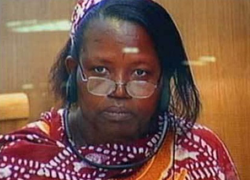
Nyiramasuhuko, often referred to as simply “Pauline”, is first woman at the Rwanda Tribunal to be charged with genocide and the only women ever to be convicted. Pauline’s case concerned the town of Butare in Rwanda, a University town whose mayor bravely resisted the national government’s unfolding genocidal plans providing a safe harbor to thousands of desperate Tutsis. Nyiramasuhuko was instrumental in having the mayor sacked and later murdered to pave the way for the killing. She then proceeded to be a pivotal figure in the massacre of thousands of Tutsi refugees.

Pauline Nyiramasuhuko
Nyiramasuhuko was the first woman to be convicted of rape as an act of genocide. After the genocide but prior to her arrest, she was interviewed by the BBC in a Congolese refugee camp in 1995. She told the BBC she was not involved in the killings: “I couldn’t even kill a chicken. If there is a person who says that a woman, a mother, could have killed, I’ll tell you truly then I am ready to confront that person.” It turns out, this woman and mother not only had many Tutsis killed based on her direct orders but also ordered many women to be raped.
Nyiramasuhuko was the Minister of Women’s Development in Rwanda. Nyiramasuhuko held a Ministerial post in the extremist Rwandan government. It was cruel irony that the Minister of Women’s Development so brazenly ordered women to be raped and machete’d to death.
Nyiramasuhuko was convicted of conspiracy to commit genocide. The Nyiramasuhuko case was one of the rare cases where a Rwandan Trial Chamber issued a conviction on the conspiracy mode of liability. More often than not, Trial Chambers have not been persuaded by the evidence offered by the prosecution that an agreement to commit genocide existed. Only the Nazis wrote down their explicit genocidal plans, for the other genocides the evidence of conspiracy tends to be circumstantial. In Pauline’s case, however, the Trial Chamber found that the evidence clearly established Pauline audaciously conspired with her son and others to eliminate the Tutsi in Butare.
Nyiramasuhuko was the first person to be convicted for committing genocide with a son. The one thing you can say in Pauline’s favor is that she had a close-knit family. One of Pauline’s co-defendants was her son, Shalom Ntahobali. Evidence at trial established that Pauline ordered her son to abduct and rape Tutsi women. And being a good son, he complied.
Posted in David Akerson, TVFA Posts