Tag Archive | "China"

Critical Analysis: What’s up with North Korea?

University students punch the air as they march through Kim Il Sung Square in downtown Pyongyang, North Korea (BBC)

University students punch the air as they march through Kim Il Sung Square in downtown Pyongyang, North Korea (BBC)

Since being sanctioned by the UN in March for carrying out a third nuclear test, Pyongyang has threatened nuclear strikes on the US, formally declared war on the South, and pledged to reopen a nuclear reactor in blatant defiance of UN Security Council resolutions.

On Friday, North Korea warned it would not be able to guarantee the safety of foreign embassy staff if war broke out. But not a single country seems to be taking this threat seriously. Foreign embassies in the capital of Pyongyang appear to be staying put so far despite a warning. Russia is considering the request seriously. However, the British have brushed it off, considering the threat “part of a campaign of continued rhetoric” and asserting that North Korea is insinuating that it is making the request because the US poses a threat to North Korea.

Is war on the horizon?

General Walter Sharp, who until last year was the commander of US forces in Korea, explained the escalation problem to NPR.  The “counterprovocation” plan, that the US intends to invoke if the North Koreans launch even a limited artillery attack on South Korea, authorizes the South Koreans to fire back immediately. As defensive plan, at the root it is an “if you are fired at, fire back.” But this could easily mean war. U.S. officials say the counterprovocation plan and the U.S. flexing its muscles send three strong messages: the South Koreans see that the U.S. military is standing behind them; the North Koreans find out what they’d face were they to start something; and China sees how high the stakes are and why it may need to rein North Korea in.

Furthermore, the Pentagon decided to delay an intercontinental ballistic missile test that was scheduled for next week at Vandenberg Air Force Base in California, for fear that it would only intensify the tensions between the US and North Korea. North Korea has become angered by the military exercises that the US and South Korea are doing. These exercises demonstrate potential power the two allies have to strike back: B-2 bombers and F-22 fighters, and ballistic missile defense-capable warships.  But while the US is taking the threats seriously, leaders continue to say that there are no obvious signs that North Korea is planning for a large-scale attack.

Does North Korea have any support internationally?

Even China, North Korea’s longtime ally, is speaking critically of North Korea’s recent activities. “No one should be allowed to throw a region and even the whole world into chaos for selfish gains,” said Chinese President Xi Jinping at an economic forum in Hainan province. Avoiding mentioning North Korea by name, Xi said, “[w]hile pursuing its own interests, a country should accommodate the legitimate interests of others.”

Chinese officials who value stability above all else will probably not abandon North Korea altogether during these tensions. But seeing an opportunity amid Chinese frustrations, the Obama administration is attempting to push Beijing to take a much stronger stance against the renegade country than it has in the past. China is tightening its stance; it wants dialogue to ease tensions, not war.

Mimi Faller is a 2L at DU Law and a Staff Editor for the Denver Journal of International Law and Policy.

Posted in DJILP Staff, Mimi Faller, TVFA PostsComments (0)

Critical Analysis: Maritime Tensions between China and Japan Increase

Tensions between China and Japan  increased last week over the ownership of Senkaku and Diaoyu Islands. (Christian Science Monitor)

Tensions between China and Japan increased last week over the ownership of Senkaku and Diaoyu Islands. (Christian Science Monitor)

Maritime disputes between the Japanese and Chinese continue to escalate. The Japanese-named Senkaku Islands, and the Chinese-named Diaoyu Islands continue to be a major source of conflict between the two nations. Last week, the situation escalated when Japan scrambled fighter jets after a Chinese plane flew over the islands.  Though other island disputes between these and other countries exist, this is the first time the dispute over these islands has involved aircraft. These territorial tensions have only risen since Japan purchased three of the islands from a private owner three months ago.

Both countries have attempted to claim the right to these islands since the United Nations survey declared that the islands were rich in resources, the most important being oil. The issue has only increased as oil prices have risen in both countries. This latest action on the part of the Chinese is apparently one part of a strategy of steady escalation in an attempt to reclaim the islands. Since September, Chinese ships have been spotted in waters close to the islands, including warships and law enforcement patrol boats.

The presence of the Chinese Navy and Air Force is only making the situation more dangerous. China is trying to “unilaterally change the status quo of the islands” by using its forces as evidence of their longstanding claim over the islands. All action taken has been in hopes of deterring Japan from further developing the islands, but this recent escalation goes to show that the problem could soon get out of hand. Not only is the situation, which has enraged Chinese and Japanese citizens alike, becoming more volatile, it is also causing economic damages to both nations. Reports are now saying that these economic consequences could be disastrous.

The United States has not abstained from making declarations on these disputes. While the United States maintains that it takes no side on this territorial dispute, Washington acknowledged its belief that the islands belong to the Japanese. The United States has also officially voiced its concerns over the situation, stating that rising tensions and miscalculations could have serious negative consequences.

There seems to be no sign of tensions easing in the near future either. Japan maintains that it will strengthen the surveillance power of its air force and continues to lodge complaints with the Chinese government over the dispute. As Japan maintains official control over the islands, China’s recent actions are a violation of international law, which forbids one nation from entering another nation’s airspace without having permission.  Furthermore, a nation also has the right to expel unauthorized aircraft with force. One can only hope that force will not be necessary to resolve this dispute.

Bailey Woods is a 2L and a staff editor on the Denver Journal of International Law and Policy

Posted in Bailey Woods, DJILP Staff, TVFA PostsComments (0)

Critical Analysis: China’s Upcoming “Elections” and Xi JinPing


Xi JinPing kicks a Gaelic football during a February visit to Ireland. (Wall Street Journal)

Xi JinPing is a likeable figure to the Chinese people: a fan of soccer and Hollywood war movies and married to a glamorous woman who is a famous Chinese folk singer. At ease with himself, the population is placing its confidence in this burley man with a deep, sonorous voice. Xi JinPing has some big shoes to fill. Not only is China a massive economic powerhouse, but also the Communist party is struggling with some heavy corruption. Dubbed the “fifth generation” of leadership, JinPing follows internationally known leaders that built a powerful country arguably more quickly than any other. Some analysts believe that China’s economic development model, which has delivered tremendous growth but at great environmental and social cost, is now unsustainable. As a result, JinPing must find a way to adapt a Leninist system of government to 21st-century economic problems and the political dynamics of the social media age.

Officially rising to the country’s top post as the chairman of the Politburo this Thursday, Beijing is preparing for a grand ceremony. The meeting to elect the new officials of the Chinese government, however, is not open to the public or available to media. Indeed, Internet searches have revealed new “censors” restricting searches with the party name included and any possible substituting words. On Thursday, some 2,268 delegates will elect 370 representatives to serve as the party’s central committee, who will in turn elect the two-dozen members of the Politburo. The Politburo then elects the seven- or nine-member Politburo Standing Committee who will become the epicenter of China’s power. All of this is completely hidden from the public eye.

China’s growth and the issue of US jobs being exported to China were hot topics during the recent presidential election in the United States. Now, with Xi JinPing as a rising political star in China, the United States will have to come to terms with a continuing economic battle. We, and the rest of the world, know what the United States struggles with because of media disclosure – the issues of our election were heavily discussed, from education and job growth to rebuilding our housing market. In stark contrast, we do not know the full extent of China’s struggles because the media is not allowed and is not privy to those discussions that may matter most to the public. In official deliberations, the issues are hidden behind ideological code phrases.

China’s challenges may hinge on the government’s lack of checks from the people and the media. Information is censored, government deliberations and decisions are not transparent, and many of the 1.3 billion inhabitants in China are oblivious of government policies and practices and why they exist. While the elections in the United States and China may occur contemporaneously, the processes and levels of disclosure are worlds apart.

Mimi Faller is a 2L at DU Law, and a Staff Editor for the Denver Journal of International Law and Policy.

Posted in DJILP Staff, Mimi Faller, TVFA PostsComments (0)

A Discussion with Chinese Legal Activist Chen Guangcheng

Remember this guy? Back in May he was on the cover of the Economist, this past week, three of the Sturm College of Law’s students got to hear him speak at International Law Weekend at Fordham University Law School in New York City. Did we mention we also represented yours truly, the Denver Journal of International Law and Policy?

Chen Guancheng
(Getty)

Mr. Chen is a blind, self-taught legal activist from China. Prior to April of this year, he had been on house arrest for 19 months after he took on the local party over the abortions and sterilizations it enforced as part of China’s strict one-child policy. On April 22, 2012, he fled to the American Embassy in Beijing, where he stayed temporarily. His departure from the Embassy raised some questions about whether the US had offered him enough support. But that seems water under the bridge now – Mr. Chen is currently our co-student and is getting his J.D. from New York University.

Your author, at least, considers it a great honor to be attending law school at the same time as someone who has done so many great things in the name of the law. His dedication, courage, and compassion serve as an example of what all of us can be. Not to mention, when we feel like complaining about finals coming up, remember this guy taught himself law and then took to the streets as a “barefoot lawyer” – putting himself at risk to help those in need. Finals indeed may be one of those “first world problems.” So study on, my friends.

Below are some highlights from his conversation with the moderators and the audience. Jerome Cohen, Professor at NYU Law, was the moderator and translator. Ira Belkin, Executive Director of the US Asia Institute at NYU Law, was also a panelist.

Q: How did you get interested in the law in China?

A: I recognized that people’s rights were being violated, it was the government. Disabled people couldn’t find [or] afford lawyers. So the only thing was to learn the laws ourselves, protect ourselves. To wait for the government was not practical.

Q: What is your educational background?

A: I didn’t go to school until I was 18, but I was educating myself on society and social problems before then. At that time, I really valued the opportunity to go to class. It was difficult for me to follow the curriculum, but I did the best he could to keep up. I first started learning Braille, but then I took the regular curriculum. My major was traditional Chinese medicine, traditional massage. There wasn’t a lot of opportunity to go to university.

Q: Describe the first case you handled.

A: In 1991, there was a new law passed for people with disabilities. There were provisions people in the countryside who could not work didn’t have to, as well as providing other protections. But it didn’t really work out that way –disabled people were still discriminated against. At that time there was a village Party Secretary who went on a tirade against people with disabilities, saying they were useless to society and if it was up to him they would kill them. When I heard about this case, I showed my friends the law about people with disabilities, and we decided to do a administrative law suit.

Q: Why didn’t you find a local lawyer to support you?

A: This is a case suing the government. You can offend them –most lawyers didn’t/don’t want to take on those cases. Disabled people tend to be poor –that’s another reason. Legal aid lawyers in China were useless as well. Its only when other lawyers get interested that they become interested.

Q: Did the Association of Disabled Persons help you?

A: In terms of protecting fundamental rights, they’re not of great help. They’re an arm of the government.

Belkin: Deng Xiaoping’s [former “paramount leader” (head of the Party) in China] crippled son, Deng Pufang. Funny thing was when they needed help, they didn’t get it from ADP, they had to look locally.

Q: Can you share with us some of your early experiences in court in China?

A: In the first case I handled, the judge was sympathetic and gave us a just verdict. But later on, the judges were influenced by the Party Legal Committee, and were basically in the league of the government and weren’t helping us either. In the beginning, courts just refused to take cases. Local officials said to me that the law may be on paper, but actually enforcing it is up to us. We would go to one court, they would say we needed to go to another level court, and so on. We would do that –it was difficult for people with disabilities –but in the end, the courts didn’t help us. So in the end, I mailed the case file to the court so they could make a decision, so they accepted the case, but didn’t give us a just verdict anyway.

Belkin: It’s important to understand that geography is destiny. The village is so far from the various levels of government. The cost, time, work, money –it’s a challenge to try to use law in those circumstances.

Q: Why do you still have faith in the law?

A: The law can be a social tool, a tool to accomplish things in society. I hope that one day in China there will be rule of law, and it can be used as a tool. But right now the government is using it as a tool, so its not playing the positive role that it should.

Q: At the School for the Blind University, was he already interested in constitutional law?

A: The Constitution is a basic law –everyone should it obey it. It is only when everyone obeys it that we can all be safe and the law can be of use to us. I feel that the law not only can regulate life, provide a standard set of rules for living. But more importantly it can also control and limit government officials –create a zone in which they must act –prevent them from abusing their power. Morality, rules of ethics, can be important for people, but they don’t have any effect on the people in power. Its really the law that should serve that purpose.

Q: With regard to the role of the local Political Legal Party Committee –one of the major questions confronting the new leadership next month is are they going to reorganize the scope of authority of the party political leadership? Not only in the central government, but in the localities.

A: In China, the Party is separate from the government. It’s really the party that decides and controls how the government makes decisions –on all levels. The Party Secretary is the top official, the government is below them. The Political Legal Committee (PLC) is part of the party, that controls the government. It controls all judicial organs –police, Procurator General (Prosecutor)s, courts. So for example the public security officials should be deciding whether to investigate based on the law, but they have to do get permission from the PLC and do what the PLC says to do. The Chinese Procurator General (Prosecutor)s have a corruption case, they have decide whether to investigate, how far, whether to turn over to judicial. They have to take directions from the PLC. When it comes to the courts, especially in high visibility cases, the court needs to listen to the Party Secretary, the PLC, about what type of sentence to impose. There’s no independence of the governmental organs. When you bring it up, the government officials will say we know these decisions are wrong, but there is nothing we can do, this is what the PLC wants us to do.

Belkin: Right now, Mr. Chen’s nephew, Chen Kegui is before the Procurator General (Prosecutor)’s office. It was sent there by the police after holding him incommunicado for many months. We’re waiting to see what the Procurator General (Prosecutor) will do. Will he follow the recommendation of the police to indict the nephew  despite the nephew’s evident good case of self defense? Will he be charged intentional infliction of harm? And therefore since almost everyone the police ask to be indicted gets indicted and everyone who the Procurator General (Prosecutor) indicts gets convicted, will be be then sentenced to 2-3 years in prison at least?

Mr. Chen: This is a very typical case when the Party infringes on the rights of citizens. In this case, people climbed over the walls of my nephew’s house in the middle of the night, entered his house. My nephew just tried to protect himself and his family, but the law doesn’t protect him and hasn’t protected him. In these situations people within and without China are really afraid to confront the government. But we should be very clear when we face injustices like this we should just tell the government no.

Q: (from audience) What can US lawyers do?

A: Have US lawyers associations register their complaints with Chinese lawyers associations. Granted, Chinese lawyers associations are part of the government. Help people that are suffering speak out.

Belkin: They are trying to get NY law firms that do business in China to be interested in this. It hasn’t been very successful –you can imagine the practical difficulties –they don’t want to give up their competitive advantage. When I was in practice, other American law firms tried to use the fact that I had protested publicly and wrote things publicly against June 4, 1989 to prevent my firm from getting registered in Beijing. But what can we do practically? At least broaden people’s knowledge –let people know that we’re aware of it. Ask our firms what their positions are. The best work is through US Bar Associations –NY Bar is active.

Q: (from audience) Following the Constitution might not be the best. The Bill of Rights is kind of a laundry list of rights without any obligations. What was the actual and potential role of the Procurator General (Prosecutor) in trying to extend the rule of law in China?

A: He was meaning that the rule of law already exists, which it doesn’t yet. He knows the laws need to be amended, there are lots of bad laws now. As for the second question, it’s the Party Secretary that occupies the highest position, and the Vice Party Secretary occupies the second highest position. The Procurator General (Prosecutor), the head of police, or the head of the court, are assistants to the Party and VP Secretaries. So they work for the Party, and have to listen to them. So really they can’t make the difference because they don’t make the decisions themselves.

Belkin: They’ve revised Constitution a few times to protect human rights, foster the rule of law. The problem is its just not happening. The Procurator General (Prosecutor) is supposed to be more than just a Prosecutor – he’s supposed to be the watchdog. This was inherited from the Soviet Union, which got it from imperial Russia, which brought it in from Sweden. The idea is you have an official who would go out and investigate the legality of the conduct of government officials –something like the role that our Congressional Committees do –an investigatory role.

Q: (from audience) What role is social media having in China?

A: Its been very useful. In the past the media was completely controlled by the government. But now with social media the people can have their own voice and be a watchdog on the government. Now people inside and outside can hear other perspectives besides the governments.

Belkin: Of course it can be a two-edged sword. Sometimes the media has been mobilized in ways that have countered the rule of law –sometimes leading to the execution of people the courts didn’t think should have been executed. The government has also learned how affirmatively to misuse the media through their own hired staff –to have their own version of public opinion. This is a struggle. By and large, however, this is the most encouraging thing that has happened in the development of rule of law.

Jaime Menegus is a second year law student, on the Executive Board of the International Law Society, and a member of the Denver Journal of International Law and Policy.

Posted in Jaime Menegus, TVFA PostsComments (1)

Critical Analysis: China Continues Developing Hydropower Dams Along the Mekong River

The Dachaoshan Dam on the Lancang or Mekong River in Yunnan Province, southern China. (Atlantic Sentinel)

China recently announced that its Nuozhadu Dam, the largest dam on the upper reaches of the Mekong River, has begun generating electricity.  The Nuozhadu Dam joins four other Chinese dams along the Upper Mekong River, all commissioned to help China double its overall hydropower capacity to 300 gigawatts by 2020.  The Nuozhadu itself will eventually produce 24,000 gigawatts of electricity per year.

China is not alone in pushing for hydropower projects along the river.  Amongst the Mekong states, there are more than 130 hydropower projects “either operating or projected for the river and its tributaries.”  However, environmental experts warn that the proliferation of dams along the Mekong threatens the river’s ecosystem.  According to studies by the Stimson Center, a Washington think tank, hydropower projects along the Mekong “are already altering the river’s hydrology and impeding the flow of nutrient-rich silt that sustains soil productivity, nurtures fisheries and keeps the sea at bay in the Mekong Delta.”  As the largest inland fishery in the world, environmental harm to the river could prove devastating.

The unsustainable exploitation of the river is also generating political strain.  As water resources become increasingly important to powering the region, conflicts may arise over access and use of the river.  Vietnamese President Truong Tan Sang recently expressed this concern: “[t]ensions over water resources are threatening economic growth in many countries and presenting a source of conflict especially given the efforts of all countries to step up economic development.”

In turn, the Mekong Delta faces a crisis: on one side there exists a demand for energy to fuel developing economies; on the other, a plea to stem overexploitation and prevent devastation to both the physical river and its ecosystem.  Surprisingly, the countries along the Mekong River have already put together a modern watercourse treaty to facilitate the river’s sustainable development: the Agreement on the Cooperation for the Sustainable Development of the Mekong River Basin.  The Mekong Agreement is impressive in its incorporation of the guiding principles of international water law, including “cooperation.”  However, China continues to exclude itself from this agreement.

The sustainable development of the Mekong River will only be possible through improved cooperation.  China’s absence – and ongoing, unrestricted development of hydropower – undermines the treaty’s effectiveness, thereby threatening the Mekong River, its ecosystem, and the other countries depending upon it.

 Frank Lawson is a 4LE and Board Member on the Denver Journal of International Law and Policy.

Posted in DJILP Staff, Frank Lawson, TVFA PostsComments (0)

United States Must Monitor Island Dispute in the South China Sea

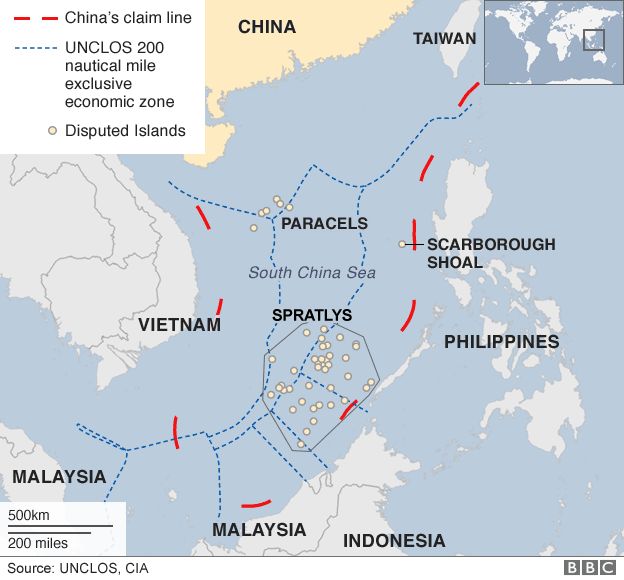
China is embroiled in maritime territorial disputes, not only with Japan over control of a group of tiny islands in the East China Sea, but also with The Philippines, Vietnam, Malaysia, and Brunei over the island chains of the Spratleys and Paracels in the South China Sea.  The dispute with Japan over the Senkaku (in Japanese) or Diaoyu (in Chinese) Islands has led to angry and violent anti-Japanese protests and demonstrations in over 80 Chinese cities.

(Energy Information Agency)

The dispute between China and Japan over these islands dates back to 1895, when Japan took control of them during the first Sino-Japanese War.  The crisis was a reminder of Chinese humiliation, coinciding with the anniversary of the September 18, 1931, Japanese invasion of Manchuria, followed by 14 years of occupation.  The Japanese government’s purchase of three of those islands from their private Japanese owners acted as the trigger for the demonstrations.  China considered the purchase a gross violation of its sovereignty, although it has never physically occupied the islands.

The islands, which are rich with fish, oil, and natural gas, are physically controlled by Japan, and are also claimed by Taiwan, which is geographically closer to the islands than China.  China asserts a historical claim but Japan says that China’s interest in the territory followed only after studies showed that the waters were rich in natural resources.

In the South China Sea, the US is involved because Beijing has claimed much of the South China Sea as its territorial waters since the early 1990s, which means that foreign ships need to obtain China’s permission before entering those waters.  The South China Sea is a strategic international waterway, through which more than one-third of the world’s commercial trade passes, and hence the seafaring nations of India and Australia are also concerned.

While Beijing claims that these islands are an integral part of its territory for the last 2,000 years, Vietnam disputes it, claiming both island chains to have been under its rule since the 17th Century.  The Philippines claims are based on geographical proximity to the Spratley Islands and Malaysia’s and Brunei’s arise under the United Nations Law of the Sea Convention as the territory falls within their exclusive economic zones.

China has been flexing its muscles regarding its maritime claims, as it needs energy and both the South China Sea and the East China Sea are energy rich.  Also, the area is seen as immensely useful to China’s nuclear strategy, as well, as it seeks to possess a credible sea-based nuclear deterrent.

China Flexes its Muscles in the South China Sea
(World Crunch)

The Association of South East Asian Nations, to which all these countries but China belong, has been seeking to resolve the territorial disputes by peaceful means.  However, at a recent meeting of ASEAN in Cambodia, the countries could not even agree on a communique because China did not want any regional negotiations to resolve these competing territorial claims, instead preferring bilateral agreement.  US Secretary of State Hillary Clinton supported regional negotiations and a binding code of conduct in that region, which China dismissed as meddling in its internal affairs.

The US has often signaled China that its interest lies in upholding the principle of the freedom of navigation but China remains suspicious, contending that the US has been reassuring the other countries that it supports their claims against China and is intent on containing China.

The US has repeatedly assured China that it is neutral in territorial disputes across the region, and both Secretaries Clinton and Panetta have called for peaceful resolution of territorial disputes among these states in accordance with international law and the Law of the Sea Treaty.  However, the US is under a treaty obligation to come to Japan’s aid if it is attacked.

On his recent visit to China, Defense Secretary Leon Panetta spoke with Vice President Xi Jinping, the presumptive next President, who condemned Japan’s purchase of the islands as “a farce.”  Other Chinese officials have threatened Japan with unspecified “further actions.”

The stakes are indeed high, as these disputes can lead to dangerous missteps and perhaps even the use of force.  Thus, the US efforts to find a peaceful resolution are critical.

Ved P. Nanda is a distinguished Professor of International Law at the University of Denver Sturm College of Law.

Posted in TVFA Posts, Ved NandaComments (0)

Critical Analysis: China’s One Child Policy

A Chinese woman who was forced to abort her 7-month old fetus has found herself in the center of international controversy after she claimed that local officials were holding her in the hospital against her will and that her husband had disappeared.

Twenty-three year old Feng Jianmei and her husband Deng Jiyuan, who already have a five-year old daughter, had been ordered to pay 40,000 yuan ($6,300) for violating China’s strict one-child policy. When they failed to pay the fine, Jianmei was reportedly beaten and forced to sign an agreement for an injection that induced her late-term abortion. Media caught wind of the story when graphic photos of Jianmei lying next to her aborted daughter were posted online. Local news media reported that the family had consented to the abortion, but Jiyuan had vehemently denied that.

The young parents have also been the center of criticism for being traitors for talking to foreign media. The family’s comments to foreign media outlets were met by protesters carrying banners accusing Jianmei and Jiyuan of treason.  Jiyuan’s sister told a Hong Kong newspaper that he was being followed by security officers when he visited his wife in the hospital. He had planned to bring Jianmei home, but that plan was interrupted when unknown men prevented him from getting into a taxi at the hospital.

The case has sparked anger over the practice of forced abortions and sterilizations under the guise of China’s one-child policy.  China has been implementing the strict one-child policy since the 1970’s as a way to control its increasing population. While it is illegal under Chinese law to undergo such a late-stage abortion, government officials have been known to compel women to have abortions to meet the country’s birthrate targets.

The government has since suspended three of the family planning officials who were involved in the forced abortion, and required them to apologize to the young woman. The local government has also offered the family some compensation.

Aiden Kramer is a rising third year law student at DU and the Executive Editor of The View From Above.

Posted in Aiden Kramer, DJILP Staff, TVFA PostsComments (0)

Critical Analysis: China’s Twelfth Five-Year Plan Looks to the Sky

Having weathered the global recession with surprisingly few troubles, China is looking for ways to sustainably grow its economy.  This goal is reflected in China’s Twelfth Five-Year Plan – the intended economic course charted by the central government.  Unlike the Five-Year plans of the Soviet Union, China blends central planning with a healthy acceptance of entrepreneurship.  With this newest plan, China hopes to catapult itself into the developed world.

China’s pro-growth rhetoric and policies are making waves in Asian and commodity market; both are surging in anticipation of stimulus measures implemented by the world’s second largest economy.  Despite strong performance over the last few years, the decrease in local and commodity imports suggest China’s economy is not as strong as the numbers suggest.  In light of this shadow and a visit to the important industrial city of Wuhan, China’s Premier Wen Jiaboa wants to step on the economic accelerator.  This likely means more freedom for local governments “to undertake large-scale investment projects.”  Although monetary policy reform will not offer much short-term relief, incremental fiscal injections have the best chance of stimulating the kind of growth China is looking for.

The newest Five-Year Plan includes an unprecedented focus on climate change and environmental issues.  Consequently, there is a strong focus on efficiency, carbon emission reduction, and sustainable energy.  Building off earlier successes in promoting industrial efficiency, the new Plan intends to expand efficiency to existing buildings and other sectors.  Non-fossil fuels, such as wind and nuclear power, are a focus to relieve China’s growing energy needs.  Market-based reform, however, is a theme which runs through most of the China’s new economic plan.

One other component of the Plan is a focus on transportation.  Two-thirds of the world’s current airport construction is in China.  Chinese leaders, intent on growing beyond a manufacturing economy, are looking to the skies for hope.  By focusing on the aerospace sector, China hopes to both meet domestic demands for internal air travel and increase the profile of Chinese companies abroad.  Noting that the aerospace is the United States’ largest export industry, China hopes to climb to the next level of development partially on the prestigious and lucrative wings of aerospace.  To be successful, however, the Chinese military must loosen its control over the skies – Chinese airspace is controlled by the military, which restricts civilian flights to circuitous, inefficient routes.

As China implements this next Five-Year Plan, there are bound to be impacts in the West.  A strong China will help the global economy, given its inter-connectivity.  If nothing else, a weak Chinese economy will combine with a shaky European and fragile American economy to further hinder global economic recovery.  By directing growth into areas other than manufacturing, Chinese companies will compete directly with Western companies.  In the aerospace sector, the West could potentially lose its long-held domination through complacency.

Dan St. John is the Editor in Chief of The View From Above.

Posted in Dan St. John, DJILP Staff, TVFA PostsComments (0)

News Post: Signs of Democracy in Burma

Burma: a small yet increasingly geopolitically important country to the South of China. Little has been made in recent years of this reclusive military junta until it surprised the world with its democratic by-elections this past Sunday. The National League for Democracy (NLD), the pro-democracy party in Burma, won nearly all of the seats it contested in the legislature.  Though elated with the results, the Burmese people maintain a modest posture. One citizen said, “we can’t say we are on the democratic path yet… but over the next few years, under the leadership of Aung San Suu Kyi, I think there will be more changes.” Daw  leads this incipient Democratic movement, and having won herself a seat in the national elections, takes on huge expectations in a country still dominated by men who served under the autocratic regime.

Aung San Suu Kyi

In response to these elections, Secretary of State Hillary Rodham Clinton announced the Obama administration would ease sanctions against Burma, however; this move falls short of what the Burmese government expected. The harshest sanctions against Burma are targeted at the military and current government. They forbid international banks from conducting transactions with the country, rendering Burma unable to use credit, and, to make matters worse, they may only be repealed with Congressional approval. The administration plans to bypass Congress on national security grounds to repeal some of the lesser sanctions. Additionally, the U.S. plans to name an ambassador to Burma, establish a USAID mission and United Nations development program, allow non-profits to start initiatives focused on democratic movements, health, and education, and begin issuing visas to select government officials.

On its face, this sounds like a genuine response to humanitarian progress in Southeast Asia. Surely, this is all a consequence of Obama’s much touted approach to engage with authoritarian regimes and “meet action with action.” Not so fast, says George Friedman, geopolitical analyst and owner of the private intelligence analysis agency Startfor. Other, grander motives are at play here. Many, including Friedman, believe this is a smaller move in the Obama administration’s strategic “pivot” to Asia.

The Chinese have courted not only Burma, but Bangladesh, Pakistan, and Kenya over the past decade or so, building state-of-the-art port facilities in hopes of obtaining, as much as they possibly can, something China will never have: a border on the Indian Ocean. The Indian Ocean is an epicenter for global, commercial sea-lanes, and of increasing importance are those sea-lanes that carry oil and gas from the Middle East to fuel Asia’s profound economic development. Having been distracted by events in the Middle East for over ten years, the U.S. left China ample room to expand its reach threatening U.S. domination of the South Pacific region both economically and militarily. Now that the U.S. is turning its eyes towards Asia, it is reacting to China’s increased strength. Cozying up to what remains a very authoritarian regime in Burma is one such example.

China-hands will continue to watch this fascinating match-up between two geopolitical heavy-weights unfold, which undoubtedly will raise both political and legal issues concerning free access to international sea-lanes and ports, territorial sovereignty, and global influence in the Indian Ocean and South China Sea.

Posted in DJILP Staff, Michael Cox, TVFA PostsComments (0)

News Post: US Senate Reacts to Tibetan Self-Immolations

A twenty year-old Tibetan Monk, Lobsang Sherab, self-immolated on Wednesday, March 28 in the Changsha Township of Ngaba in Eastern Tibet.  He was consumed by the flames, and his body was taken away by Chinese paramilitary troops, despite pleas by fellow Tibetans to send the body to his family.  Sherab was ordained as a monk at the age of nine, and joined Ngaba’s Kirti Monastery’s dialectic college in October of 2011.

Sherab’s self-immolation is the most recent in an upswing of self-immolations by Tibetan monks and nuns, mainly occurring in the Ngaba region.  The Chinese Government began reacting to this trend in March of 2011, after a young Kirti monk named Phuntsog self-immolated, causing a show of solidarity by the other monks at the monastery.  In April of 2011, Chinese soldiers seized over 300 protesting monks from the Kirti Monastery, who have all disappeared since the seizure.  Beijing claims that these monks are undergoing “legal education” at undisclosed locations.

The nuns and monks are reacting to Beijing’s crackdowns on protests seeking freedom for Tibet, and the return of the Dalai Lama.

All this occurs as the Chinese Premier, Hu Jintao, attends the BRICS Summit in New Delhi, India, this week.  As leaders from Brazil, Russia, China, India, and South Africa gathered to discuss emerging issues for their nations, a Tibetan man self-immolated in New Delhi, and scores of Tibetan women took to the streets outside the Summit in the hope of bringing attention to the fate of Tibet.  By day two of the Summit, 162 individuals were detained in conjunction with the protest. Quite unusually, 100 of these detainees were women.

The Dalai Lama

The US Senate passed a resolution on Tuesday, mourning Tibetans who have self-immolated and died during recent anti-China protests, and urging Secretary Clinton to hold Beijing accountable for its crackdown on religious freedom in Tibet.  The resolution is not legally binding, but it sends a strong message to China that the US will continue to stand behind the legitimate rights of people of all nationalities to practice their religion freely.

The Chinese Foreign Ministry expressed firm opposition to the resolution immediately after it passed, and refuted all claims that the Chinese Government does not believe in freedom of religion.  He also urged the US Senate to refrain from interfering in China’s internal affairs.

The US could never attempt to enforce its religious values in China due to the prevailing international legal norm of sovereignty.  Failing the existence of a permissive rule to the contrary, international law does not allow a state to enforce its norms and values in any form in the territory of another state.  A state’s title to exercise jurisdiction rests in its sovereignty.  The issue may only be resolved by the Chinese Government.

Posted in DJILP Staff, TVFA PostsComments (0)

University of Denver Sturm College of Law

@View_From_Above

Resources
Visit the DJILP Newsroom

Posts by Date

May 2013
M T W T F S S
« Apr    
 12345
6789101112
13141516171819
20212223242526
2728293031  

Translator

EnglishItalianKoreanChinese (Simplified)Chinese (Traditional)PortugueseGermanFrenchSpanishJapaneseArabicRussianGreekDutchBulgarianCzechCroatianDanishFinnishPolishSwedishNorwegianHebrewSerbianSlovakThaiTurkishHungarianRomanian